
Hfengyun is an official AWS service tier partner focused on providing customers with discounted AWS billing and a range of technical support.

©2024, hfengyun. AWS Discounted Billing | AWS Partner Network
Managing the complicated AWS ecosystem can be challenging for customers. The primary question is whether you should purchase AWS resources from Amazon or through an AWS reseller. So, let’s explore resale options and see which is best for you.

Over the last decade, the cloud computing revolution has allowed organizations of all sizes to leverage the power of Amazon Web Services (AWS) to scale and grow. Cloud computing has grown into a massive ecosystem of technologies, products, and services, resulting in a multibillion-dollar economy that increases exponentially each year, with a plethora of cloud providers vying for an ever-increasing portion of the cloud computing market.
The Cloud’s popularity stems mostly from its unique benefits and the significant economic value it provides. Many recent surveys suggest that cloud services have several advantages over traditional on-premises infrastructure, including greater scalability, reliability, and cost management.
However, Managing the complicated AWS ecosystem can be challenging for customers. The primary question is whether you should purchase AWS resources from Amazon or through an AWS reseller. So, let’s explore resale options and see which is best for you.
AWS resellers are third-party firms that have been authorized by Amazon Web Services to market its cloud services. Resellers purchase AWS services in bulk at a subsidized rate and resell them to consumers. They usually package AWS offerings with other services like cost visualization platforms, consultancy, support, and managed services, such that the final bundle seems to be very profitable for the end customer.AWS resellers often cater to enterprises seeking a more personalized and tailored cloud service.
Choosing the Right Purchase Method for Amazon Web Services
To fully utilize AWS services for your firm, you must select the appropriate buying strategy when acquiring AWS resources. This has the potential to significantly impact your cost efficiency, support quality, and overall cloud resource management.
Direct Buy
In a direct purchase, an organization purchases AWS services directly from Amazon Web Services, bypassing any middlemen. Direct purchase gives enterprises more control over their cloud infrastructure. While large organizations can profit from direct purchasing, small and medium-sized firms (SMEs) and digital native businesses (DNBs) may struggle with it.
Full control and flexibility: Purchasing directly provides you with more control over your AWS resources. You also have direct access to all of AWS’s features and benefits, with no resellers in between.
Direct connection to AWS support: By eliminating intermediaries, you may speed up troubleshooting and resolution.
Cloud Cost Savings Potential: Purchasing resources directly from AWS protects you from any additional markups that resellers may apply to their services. Large businesses with a high AWS spend can negotiate directly with AWS to gain discounts or develop special enterprise agreements.
Access to all AWS programs: When you buy straight from AWS, you get access to all of the services it provides, including free tiers, starting credits, training materials, and more.
Complexity: For small businesses, operating an AWS account without reseller assistance can be difficult, as administration necessitates specialist skills.
Limited access to assistance: Free AWS support has restrictions, and businesses must pay for a premium plan, such as AWS Enterprise assistance, for more sophisticated help choices. This can raise overall costs and is not an affordable solution for small and medium-sized businesses.
Hidden expenses: While direct billing saves you money on reseller markups, unforeseen expenses may arise as a result of inadvertent resource overprovisioning or inefficient provisioning if correct cost optimization measures are not followed.
As previously stated, resellers are AWS partners: Resellers purchase AWS services in quantity at a discount and resell them to consumers, frequently combined with other services such as support. Purchasing AWS resources from a reseller guarantees a high level of support during cloud adoption. Let’s look at the advantages and disadvantages of reseller buying.
Experience and guidance: For enterprises that lack in-house AWS experience or are new to the AWS cloud, AWS resellers can help you select the correct services for your needs, build and deploy your cloud architecture, and resolve any difficulties that may emerge.
Many AWS resellers focus on specialized areas: such as healthcare, banking, or retail. They provide personalized advice and services to meet the specific needs and difficulties of your industry.
Upgraded Support and Value-Added Services: Companies can receive dedicated and personalized support from the reseller support staff at no additional cost. This is a higher level of support than the basic AWS support that you purchased outright. In addition, resellers provide value-added services such as cloud cost optimization, cloud migration support, and others.
Strategic planning guidance: AWS resellers may assist you in developing a long-term cloud strategy that corresponds with your company’s objectives. They have access to Cloud Partner Network resources, programs, and incentives to help you achieve your specific business objectives.
AWS resellers simplify billing management by unifying various accounts, and services, and using statistics in a single, easy-to-understand format.
Dependence on the reseller means less control. When working with a reseller, you may have to give up some control over your Amazon Web Services account. Billing must go through the reseller.
Challenges in switching resellers: If a reseller maintains your AWS configuration, switching to another reseller or purchasing directly can be challenging.
Professional markups: While resellers should, in theory, offer you discounts, their added support and services may incur a markup, which might raise your cloud cost.
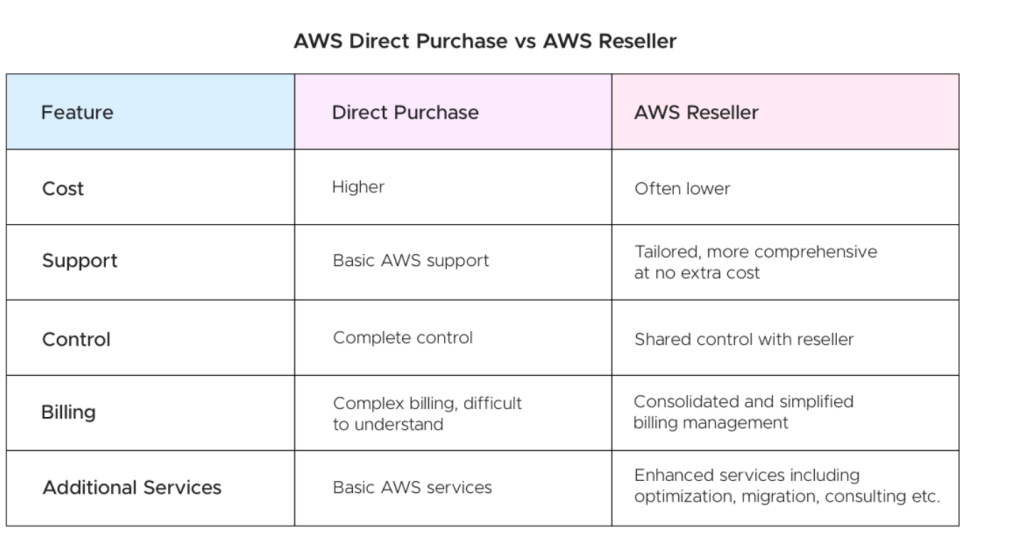
Whether you buy AWS directly or through a reseller is determined by your needs. If you’re a large firm with a strong in-house cloud team and access to volume-based pricing for AWS services, going direct may be a good alternative.
However, AWS resellers can provide valuable cost savings for those who don’t have access to volume pricing, lack cloud expertise, or need additional support. Partnering with an AWS reseller offers significant cost savings, personalized support, consulting, and more. Use the APN network to find a reseller that meets your requirements and helps you achieve your cloud computing goals.
Assessing Reseller Capabilities.
The Amazon Partner Network (APN) is one of the most trusted resources for finding a reseller. This is a listing of AWS-approved partners who have been vetted and validated. All partners are divided into four tiers (Standard, Select, Premium, and Premier) depending on their knowledge, experience, and dedication to AWS.AWS also provides a partner search tool to help you find resellers.
In addition to the APN, you can consider various things when choosing a reseller with the necessary capabilities. These include the reseller’s competence and experience, the scope of services, pricing, communication and transparency, and success stories.
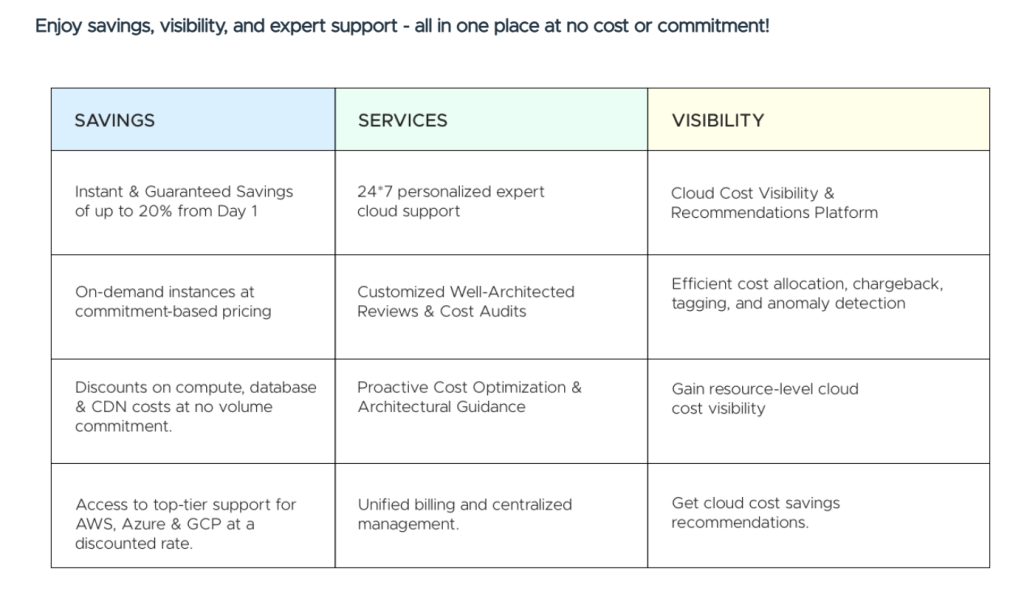
Hfengyun AZ is a top AWS reseller certified as an AWS Premier Partner, leveraging the power of group purchasing, the scale of spend aggregation, and volume-based discounts to help organizations realize significant cloud cost savings across their entire bill from day one. We make sure you get the best discounted rates in the market at no cost, no lock-in, or no commitment. In addition to securing savings, we offer a comprehensive cloud cost visualization platform and proactive support for vertical cloud cost management for your organization.
6 RAFFLES QUAY
Singapore
+65 80951058
sign230203@gmail.com
©2024, hfengyun. AWS Discounted Billing | AWS Partner Network