
Hfengyun is an official AWS service tier partner focused on providing customers with discounted AWS billing and a range of technical support.

©2024, hfengyun. AWS Discounted Billing | AWS Partner Network
SQS and S3 are essential components of systems that use cloud-based microservices architectures. Frequently, messages from SQS to S3 are required to keep track of everything in the queue. This post will go over the procedure for doing this transfer.

Amazon provides AWS Simple Queuing Service, a managed message queuing service. In the microservice architecture, queue services are commonly employed to decouple systems from services. In that sense, SQS is a software-as-a-service replacement for queuing systems such as Kafka, RabbitMQ, and others. AWS S3, or Simple Storage Service, is another software-as-a-service Amazon provides. S3 provides a comprehensive solution for any type of storage requirement up to 5 terabytes.
SQS and S3 are essential components of systems that use cloud-based microservices architectures. Frequently, messages from SQS to S3 are required to keep track of everything in the queue. This post will go over the procedure for doing this transfer.
SQS relieves developers of the complexity and labor involved in creating, maintaining, and running a highly reliable queue layer. It facilitates message transmission, reception, and storage between software systems. The usual message size is 256 KB. However, with the expanded AWS SDK, message sizes of up to 2 GB are supported. Messages larger than 256KB in size will default to S3 as internal storage. One of the most significant benefits of adopting SQS over traditional queue systems like Kafka is that it allows for essentially infinite scaling without the client having to worry about capacity planning or pre-provisioning.
AWS provides a very flexible price plan for SQS based on the pay-as-you-go paradigm, which results in considerable cost savings as compared to the always-on model.
SQS communications are stored in distributed SQS servers to ensure redundancy.SQS supports two types of queues: regular queues and FIFO queues. Standard queues ensure at least one thing: duplicate messages will occasionally reach the recipient. The FIFO queue is appropriate for applications that demand a high level of event ordering and message uniqueness. It delivers a one-time, accurate assurance.
SQS has a dead-letter queue for forwarding issues or error messages that cannot be processed under regular conditions. Amazon provides a normal queue for $0.40 for 1 million requests and a FIFO queue for $0.50 per million requests. TCO covers data storage expenses.
AWS S3 is a fully managed object storage service that may be used for a range of applications, including data hosting, backup and archiving, and data warehousing. Amazon handles all operations and maintenance activities such as scaling, provisioning, and so on, and clients just pay for the storage they use. It offers comprehensive access control via an easy-to-use administrative user interface to fulfill all types of organizational and company compliance needs.S3 also provides analytics through the use of AWS Athena and AWS Redshift Spectrum, which allow users to run SQL scripts over stored data.S3 data is encrypted at rest by default.
S3 delivers high availability by distributing data across several servers. One disadvantage to this strategy is that there is usually a propagation delay, and S3 only ensures eventual consistency. However, the writes are atomic, which means that the API will always return either old or new data, never a damaged answer. S3 is conceptually arranged into buckets and objects.
Storage buckets are the highest-level S3 namespaces that contain stored items. They are crucial to access control, and use data are always summarized at the storage bucket level. things are the fundamental storage entity, made up of real things and information. Objects are identifiable by unique keys and version numbers. Customers can select the AWS region where their storage buckets are hosted based on pricing and latency needs.
It’s worth noting that objects do not allow locking, thus if two PUTs are sent at the same time, the request with the most recent timestamp will win. This means that if there is concurrent access, the user will have to develop their own locking mechanism.
The most basic method for transferring data from SQS to S3 is to use common AWS services like Lambda functions and AWS Firehose. AWS Lambda functions are serverless functions that let users execute any logic on Amazon’s infrastructure. These functions can be initiated in response to particular events or scheduled at predetermined periods.
It is extremely straightforward to create a Lambda function that operates on a SQS message and writes it to S3. Note that this generates an S3 object for each message received, which is not always desirable. There are two techniques for transferring data from SQS to S3 after a defined interval of message buffering:
The scheduled Lambda function for SQS transfers to S3 runs at a predetermined time interval and can consume any SQS messages created during that period. After all messages have been handled, it can make API calls to generate multi-part S3 uploads. To schedule the Lambda function that transfers data from SQS to S3, follow these steps.
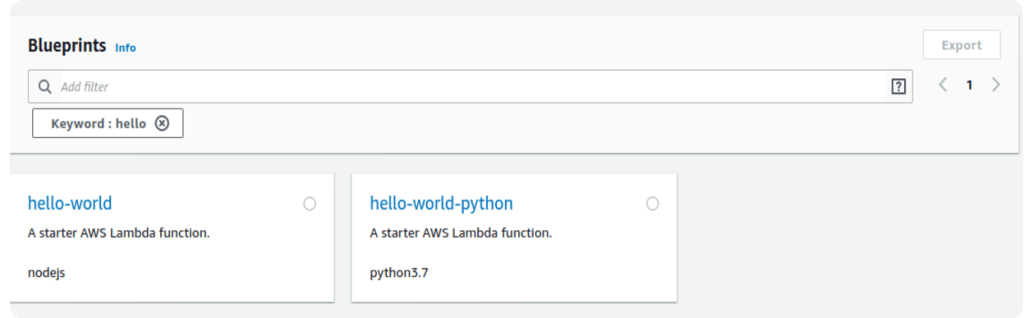
Select Create Function. On the following screen, select Add Trigger.

In the Trigger Search menu, look for and choose CloudWatch Events.CloudWatch Events are utilized for scheduling Lambda functions.
Click the Create New Rule button and pick Schedule Expression as the rule type. A Cron expression is required when using a schedule expression. You can enter a valid Cron expression that matches your execution policy.
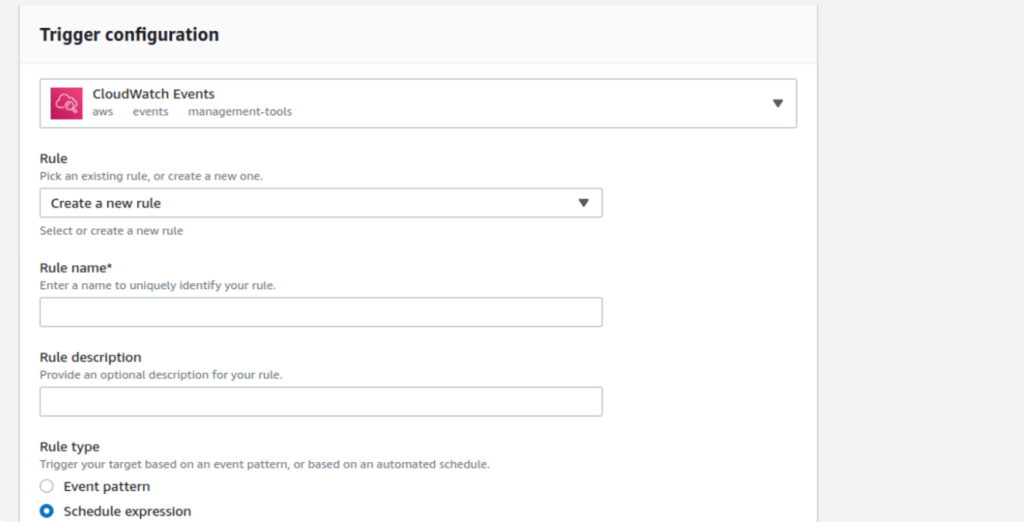
One drawback of utilizing the Trigger Lambda function to transport data from SQS to S3 is that it generates an S3 object for each message, resulting in a high number of destination files. A remedy for this issue is to utilize buffered delivery streams that publish to S3 at predetermined intervals. The steps in this strategy are as follows.
To develop a triggered Lambda function for SQS to S3 data transfer, first repeat the procedures. Choose a trigger instead of a schedule phrase. Amazon will provide you with a list of probable triggers. Select the SQS trigger and then click Create Function. Create custom code in the Lambda function to redirect SQS messages to the Kinesis Firehose Delivery Stream.
To set up a delivery stream, navigate to the AWS interface and pick the Kinesis Data Firehose console.
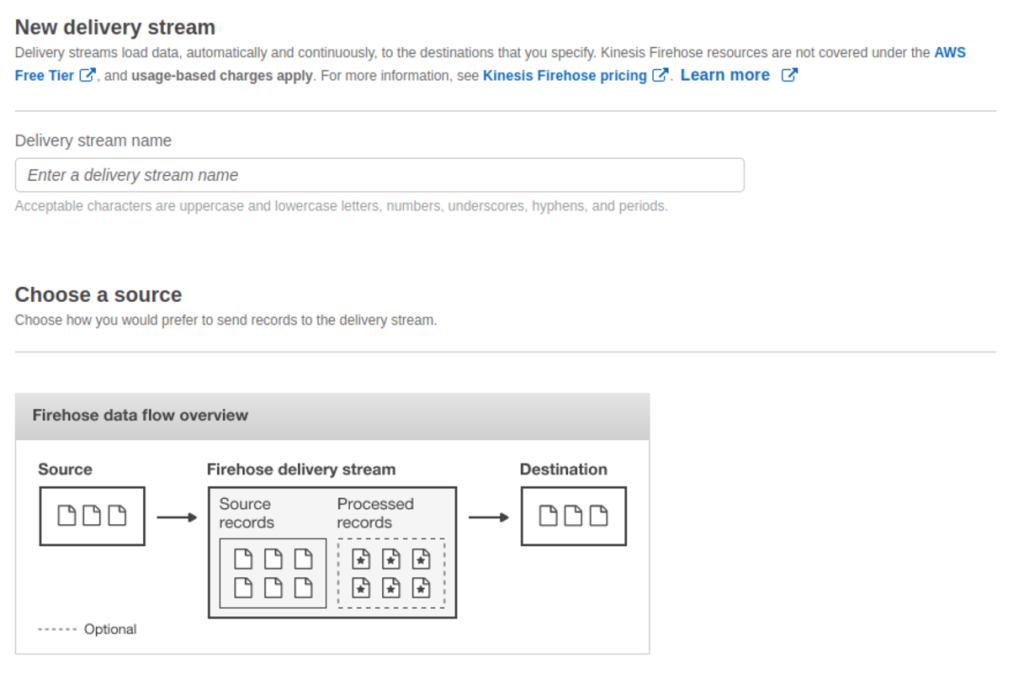
Select S3 as the destination. In the Configuration Options, you can find options for buffer size and buffer spacing.
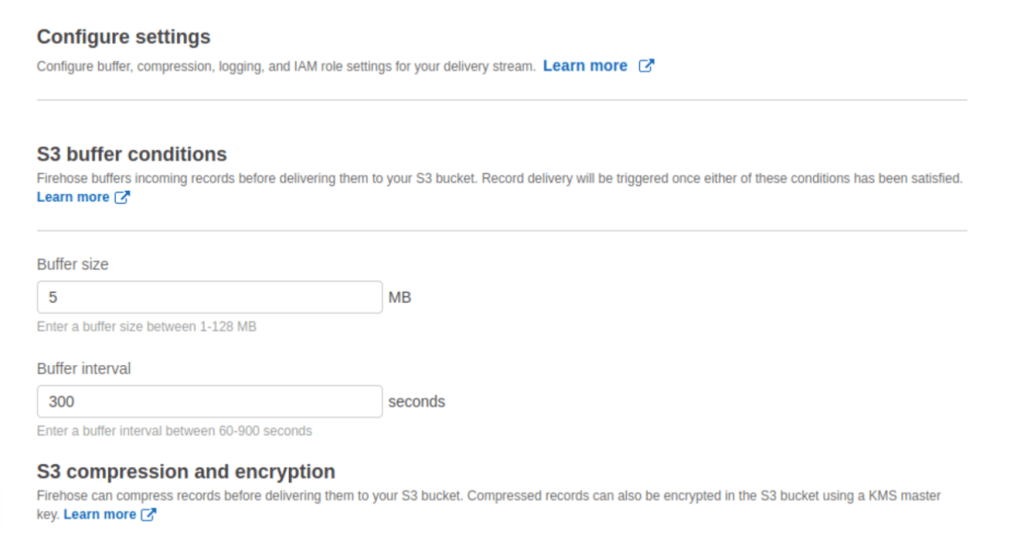
The buffer size specifies how much data the Kinesis Firehose will store before publishing messages as objects to S3. The amount might range between 1 MB to 128 MB.
The buffer interval is the length of time the firehose waits before posting to S3. You can select any amount from 60 to 900 seconds. After choosing the buffer size and interval, you may keep the remaining options at their default values and click Create. This concludes the workflow for sending data from SQS to S3.
The biggest shortcoming of this strategy is that the user has no direct control over when data is written to S3 beyond the buffer interval and buffer size constraints established by Amazon. In practice, these constraints are not always feasible.
Both of the approaches described above for transferring SQS data to S3 make use of AWS services. This has the evident advantage of allowing you to construct the full process within the AWS environment. However, these techniques have certain drawbacks, which are detailed below.
Both approaches need extensive bespoke code and AWS proprietary configuration expertise. Some of these settings are really complicated and might need a substantial amount of time and effort.
AWS sets a number of constraints on execution time, runtime memory, and storage memory for the transfer services. This is not always practicable in real-world scenarios.
In this blog, you learned how to transport data from SQS to S3 using AWS Lambda and AWS Firehouse. You also discovered the constraints of utilizing custom code for SQS to S3 data conversion. The AWS Lambda and Firehouse-based strategy for loading data from SQS to S3 is time and resource-consuming. It is also an error-prone strategy that requires continuous debugging and maintenance of the data transmission process.
6 RAFFLES QUAY
Singapore
+65 80951058
sign230203@gmail.com
©2024, hfengyun. AWS Discounted Billing | AWS Partner Network