
Hfengyun is an official AWS service tier partner focused on providing customers with discounted AWS billing and a range of technical support.

©2024, hfengyun. AWS Discounted Billing | AWS Partner Network
Everything you need to know about the AWS EDP will be covered in this book, including qualifying requirements, advice on how to get the best pricing, and suggestions for preventing future overcommitment.

The AWS Enterprise Discount scheme (EDP) is one discount scheme you should be aware of because major organizations’ AWS cloud bill quantities are enormous. By exchanging personalized discounts for long-term expenditure commitments, the EDP intends to help major AWS users save significant money. Everything you need to know about the AWS EDP will be covered in this book, including qualifying requirements, advice on how to get the best pricing, and suggestions for preventing future overcommitment.
Large enterprises and AWS enter into a contractual arrangement known as the AWS Enterprise Discount Program (EDP), which requires them to commit to a certain usage level for a predetermined amount of time, usually one to three years. AWS provides a substantial reduction on the entire cost in return. AWS benefits as it enables them to plan their infrastructure across the years that the client has committed, and it also enables AWS customers to cut back on their cloud spending drastically.
1. Discounts Based on Commitment: The fundamental idea of AWS EDP is that the more you spend, the larger the discount. Longer-term commitments and more spending are encouraged by this sliding discount scheme. There is, of course, space for compromise.
2. Customized Agreements: EDP agreements may be altered, in contrast to standard pricing structures. They are customized to meet the particular requirements, use trends, and development path of a company.
3. Accessibility across services: AWS EDP is a complete cost management solution since it integrates with a variety of AWS services. Compute, storage, machine learning, and analytics services are all covered by the EDP.
4. Multi-year agreements: The majority of EDPs call for multi-year commitments. This long-term outlook guarantees mutual benefit and matches AWS with customer ambitions.
Although yearly spending is the primary criterion for participation under the AWS Enterprise Discount Program (EDP), additional considerations are also taken into account:
Continuous Expenditure: AWS demands a minimum yearly commitment of $1,000,000, which it anticipates being maintained or raised throughout one to five years. If you make a $5 million commitment in 2024, you have to keep it up or raise it in the years that follow.
EDP Discount Exclusion: The annual commitment amount is not affected by discounts obtained through EDPs. Your net commitment will be $4.5 million if you spend $5 million and get a $500,000 reduction.
AWS Marketplace Spending Cap: Up to 25% of the yearly commitment may be spent on purchases made through the AWS Marketplace. 50% before.
Enterprise Support: To take part in the EDP, you must sign up for AWS Enterprise Support, which is an extra expense.
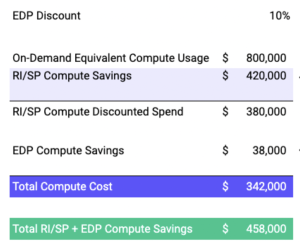
You may take advantage of both savings schemes simultaneously by combining the RI/SP and EDP discounts.
The customer’s typical on-demand expenditure in the case below is $800K. His new cloud bill, after the RI/SP reduction, is $380,000. The $380,000 cloud cost is reduced by his 10% EDP discount. The use of EDP results in a $38K reduction for him.
It is now prohibited to resell RIs acquired using EDP on the AWS marketplace.
AWS has put in place a rule that forbids users from reselling Reserved Instances (RIs) that they have purchased at a discount (using EDP) on the Amazon EC2 Reserved Instance Marketplace as of January 15, 2024. Section 5.5 of the AWS service agreements, which expressly prohibits the selling of reduced RIs, serves as the foundation for this prohibition.
Although discounted RIs acquired before October 1, 2023, could be resold on AWS, this grace period has already ended. It will no longer be possible for customers to resell cheap RIs through the Marketplace or other third-party sources.
The engineering and finance teams must work together to precisely estimate your AWS spending if you want to take full advantage of an AWS Enterprise Discount Program (EDP). By doing this, overcommitting and undercommitting will be prevented.
1. Estimate Your Growth, Spending, and Usage: Examine your past AWS expenditure information and consider variables that could affect your future spending trends. Recall that enrollment in the AWS EDP program necessitates a yearly increase in commitment. Make sure this is in line with the long-term objectives of your company. To estimate future expenses, you can utilize third-party FinOps platforms like Holori or native AWS capabilities.
OVERALL GUIDELINE: Underestimate costs You should underestimate your AWS costs and err on the side of caution. To keep your promises, you don’t want to be rushing to find ways to spend money. AWS often reduces the cost of its services over time, which may lead you to “chase spending targets” and sign up for unnecessary additional services. I’m very certain that I should put my EDP commitment at about 80% of my anticipated spending.
Assess the sellers in your AWS Marketplace: Evaluate the ISVs you presently buy from and find out if the AWS Marketplace is an option for these transactions.
Join forces to boost commitment: To boost total expenditure, think about combining your AWS budget with those of other organizational divisions, such as parent firms or subsidiaries. Better discount rates are frequently the consequence of more spending. In reality, all of the AWS accounts must be grouped under a single master account.
Develop Trusting Connections with AWS Account Managers: The EDP negotiating process heavily relies on your AWS account manager. Engaging with them regularly guarantees that you comprehend AWS’s goals, pricing policies, and possible reductions. Develop a relationship with your account manager and emphasize the advantages of an EDP agreement while expressing your long-term dedication to AWS.
Overcommitment can be caused by a variety of factors. recession, slower-than-anticipated growth, and assigning too much work to another vendor. Regardless of the cause, it’s essential to recognize your overcommitment as soon as feasible. You can reduce the effect and take corrective action sooner if you detect the issue early.
1. Shift SaaS Vendor Contracts to the AWS Marketplace: For SaaS suppliers listed on the marketplace, you can request a private offer that keeps your originally agreed conditions while enabling you to pay through AWS.
2. Transfer SaaS Vendor Contracts to the AWS Marketplace: You can ask for a private offer from SaaS vendors that are featured in the marketplace, which will allow you to pay through AWS while maintaining the terms that were initially agreed upon.
You may maximize your cloud investment and save a lot of money by comprehending the intricacies of the AWS EDP and skillfully negotiating conditions. To prevent overcommitting or undercommitting, make sure you project future spending properly. Organizations should use RI and savings programs, create budgets and alarms, and proactively monitor and optimize AWS use to fully utilize AWS EDP. You can get assistance from Hfengyun in this process:
Find more optimization opportunities than those suggested by AWS.
Work well together as a team to accomplish cost management objectives.
You can maximize the advantages of AWS EDP and make sure you get the most out of your cloud investment by utilizing Windy Cloud’s capabilities.
Are you prepared to advance your cloud cost optimization efforts? Get a free trial by registering now.
6 RAFFLES QUAY
Singapore
+65 80951058
sign230203@gmail.com
©2024, hfengyun. AWS Discounted Billing | AWS Partner Network